A Rule of Thumb Past Its Sell-By Date
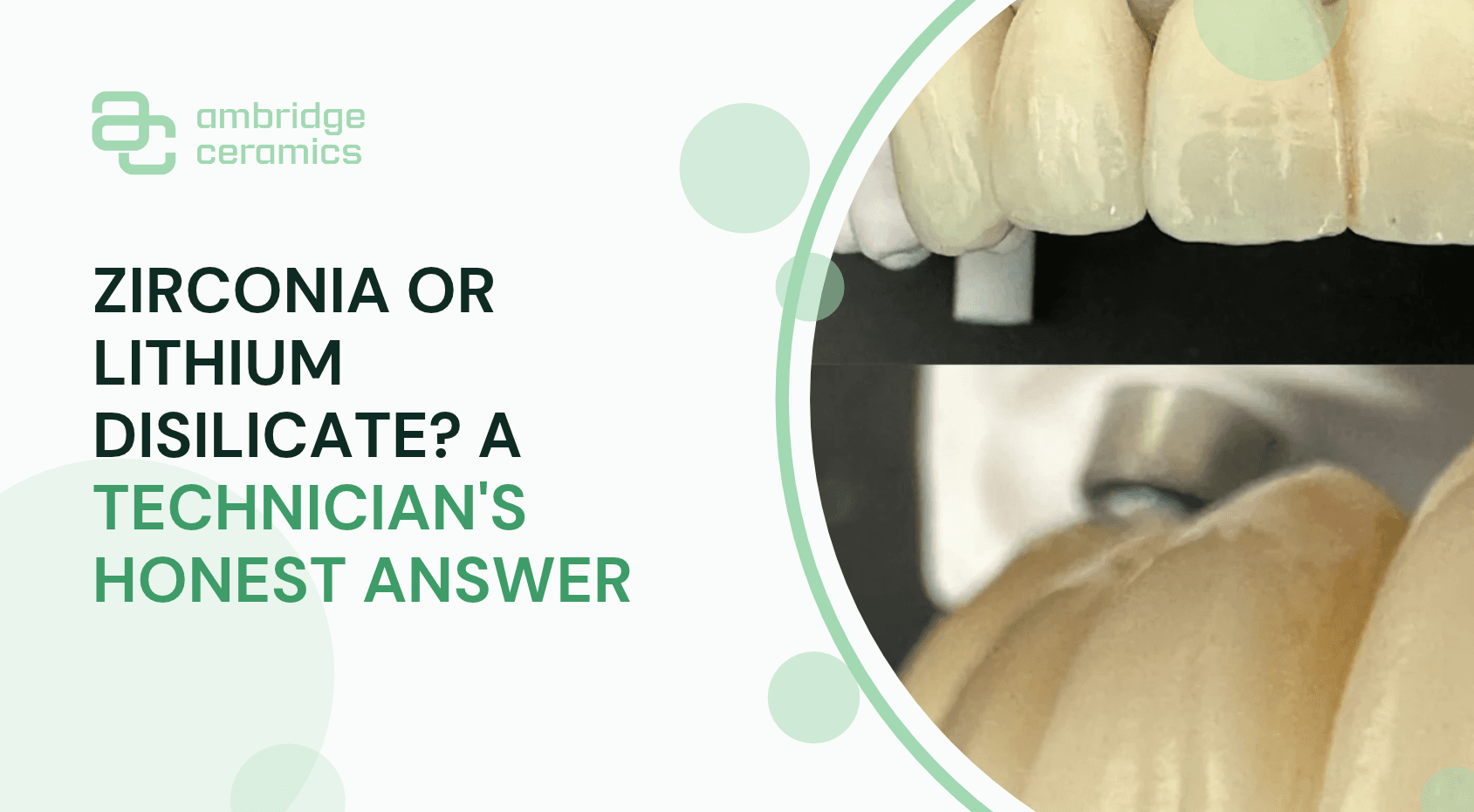
“Zirconia or e.max?” I must be asked that at least once a week. For years the answer was a simple rule of thumb: zirconia for strength in the posterior, lithium disilicate for aesthetics in the anterior.
After more than 40 years at the bench, I can tell you that rule is now out of date. Modern multilayer zirconia has changed the conversation, and many dentists haven't caught up yet. Here is how I see it in the lab today, in plain English.
Zirconia has moved on
Early zirconia earned its reputation for being strong but chalky and opaque. That reputation is now well past its sell-by date. The latest multilayer materials, such as the fusion zirconia we use, grade from a deeper body shade to a more translucent incisal edge, and their translucency is now similar to lithium disilicate.
Three things make modern zirconia a genuine aesthetic option, not just a strong one:
It blocks dark preps from the inside.
Before sintering, zirconia is slightly porous. That allows us infiltrate only the fitting surfaces with a light-blocking liquid. Once sintered, it stops a dark prep, metal post or titanium/zirconia abutment from shining through, and helps us control the final shade. Because it soaks into the material rather than sitting on top, it takes up zero luting space.
It can be cut back and hand layered.
We can design the crown with a slightly reduced labial/occlusal surface, then hand layer a feldspathic/glass porcelain over after sintering. This helps gives the natural, light-responsive effects you would expect from a layered restoration, on a very strong core.
It is still incredibly strong.
None of this costs you the strength that made zirconia popular in the first place.
Where lithium disilicate still shines
Lithium disilicate (you will know it as e.max, or LiSi) is still a superb material, typically quoted at around 400 to 450 MPa in flexural strength. Its big advantage is that it is a glass-ceramic, so it can be etched and bonded to natural tooth structure. That makes it my first choice for:
- Veneers. Thin, bonded and beautiful, where the tooth and the restoration need to work as one.
- Onlays and partial coverage. Where you want to save as much natural tooth as possible and rely on the bond.
- Minimal-prep work. When enamel is there to bond to, adhesion does a lot of the heavy lifting.
In short: if the restoration relies on bonding, lithium disilicate is hard to beat. If it relies on strength, or needs to hide what is underneath, modern zirconia usually wins.
When I reach for zirconia
Molars and premolars
Posteriors take the heaviest chewing loads, and this is where zirconia earns its keep.
Bridges
Strength in the connectors matters, and zirconia gives you the margin of safety a pontic span needs.
Bruxers and clenchers
If the patient has worn their natural teeth flat, I would rather give them a restoration that can take the punishment.
Limited space
Monolithic zirconia can be designed thinner than lithium disilicate and still be strong, which helps when the prep is minimal or the bite is tight.
Dark preps, metal posts and implant abutments
The internal light blocker is a real advantage here. It masks what is underneath where a more translucent material would let it show through.
Anteriors too
With a multilayer blank, or a cut-back and hand-layered labial surface, zirconia now holds its own on anterior crowns.
At a glance
At a Glance: Zirconia vs Lithium Disilicate
Direct laboratory comparison of clinical characteristics, flexural strength, preparation demands, and indications.
| Property / Characteristic | Modern Multilayer Zirconia | Lithium Disilicate |
|---|---|---|
| Strength | Very high | High (around 400 to 450 MPa) |
| Translucency | Similar to lithium disilicate | Excellent |
| Masking dark preps or metal | Excellent, with internal light blocker | Limited |
| Natural layered effects | Yes, with cut-back and hand layering | Yes, with cut-back and layering |
| Bruxers and heavy bites | Usually my first choice | Choose carefully |
| Bridges | Widely used | Short spans only, case by case |
| Minimal space | Can be designed thinner | Needs more thickness |
| Bonding to tooth | Bonded with the right primer, or cemented | Etched and bonded: its big strength |
| Best for | Posteriors, bridges, dark preps, most crowns | Veneers, onlays, minimal-prep work |
Treat this as a rule of thumb, not a prescription. The exact product, design and thickness all play their part.
Six questions to ask before you prescribe
Is it a crown, a veneer or an onlay?
If it relies on bonding to enamel, think lithium disilicate first.
How hard does the patient bite?
Any signs of grinding, clenching or heavy wear point towards zirconia.
What is underneath?
A dark tooth, metal post or implant abutment is where zirconia's internal light blocker comes into its own.
How much room is there?
Is there enough thickness for the material you have in mind?
How much character does the patient want?
For the most natural effects, ask us about a cut-back with hand-layered porcelain.
How will it be fitted?
Make sure your bonding or cementation plan suits the material.
If you can answer those six, you will usually have your answer. If you can't, give us a call: that is exactly what we are here for. A good digital scan, a stump shade and a clear photo help us enormously too.
The bottom line
The old “strength or beauty” choice is largely a thing of the past. Modern multilayer zirconia gives you both, plus the ability to hide a dark prep without stealing any luting space. Lithium disilicate remains the star for bonded veneers, onlays and minimal-prep work. The skill is knowing which job you are doing.
At Ambridge Ceramics we work with both every day, including our fusion zirconia and lithium disilicate, from digital scan through to the finished restoration. If you have a case you would like to talk through, pick up the phone and ask for me or one of the team on 01765 607347, or email info@ambridgeceramics.com. We would much rather help you choose than remake.
Ready to Work With Ambridge Ceramics?
Talk to our dental laboratory team about your restoration requirements and laboratory workflow. Experience consistent quality, digital precision, and technician-led technical support for your implant cases.