
MIND THE GAP (Ortho-Resto) With AC Aligners
MIND THE GAP!
Space measurement at a root level. Dental implants require a minimum of 5.5mm. This minimum size has been determined by the smallest dental implant diameter of 2.9mm, a minimum of 1.0mm space required between implant and tooth in order to allow stable osteointegration, and the final factor of 11% root relapse following orthodontics increases the total minimum size to 5.5mm.
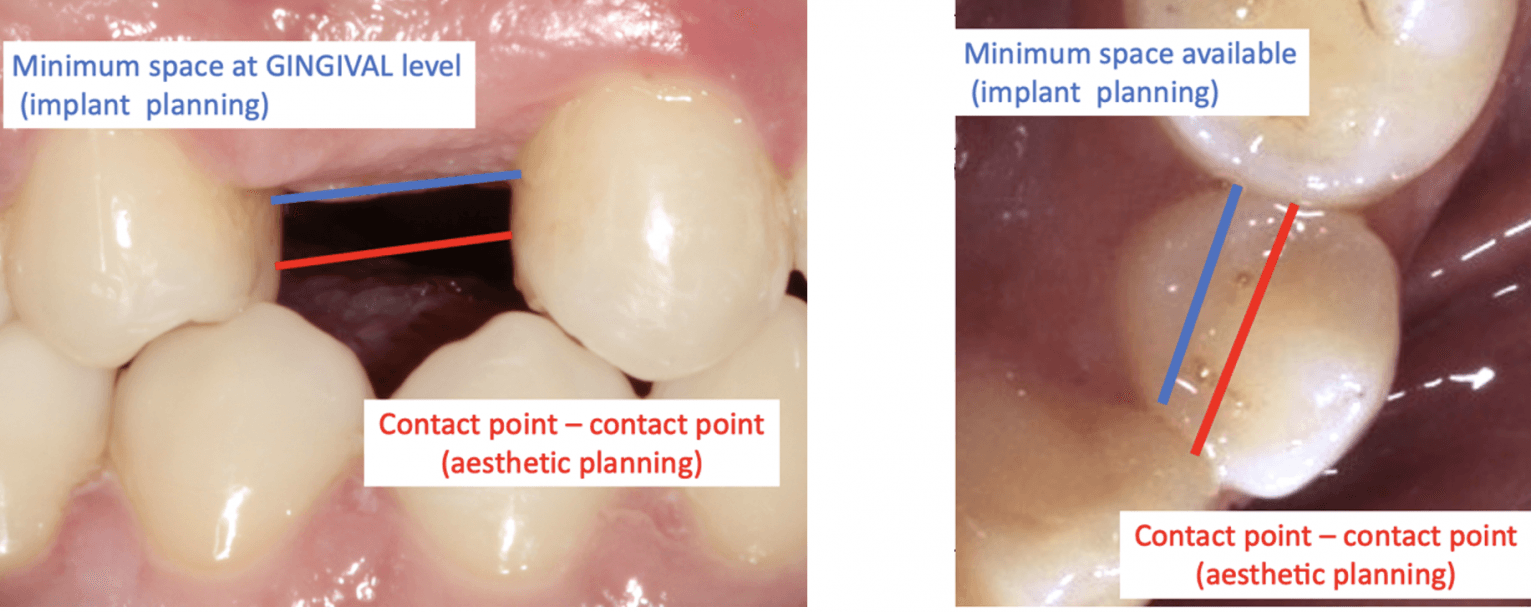
Image 1 & 2. Showing ideal position for interdental measurements
How a few months of aligners can turn an awkward space into the perfect restoration By Mark Ambridge CDT RCSed, Founder Ambridge Ceramics.
We're all familiar with the case, a patient presents with a gap and wants it closing, a crown, bridge or implant, but the space just isn't enough. The gap is too narrow for a properly proportioned tooth. Or the neighbouring teeth have drifted and tipped. Or the opposing tooth has over-erupted and stolen the occlusal space we need.
You can still make something fit, but "fit" isn't the same as "beautiful". You end up with a lateral that looks like a central's little brother, a pre-molar crown as thin as a wafer, or an implant squeezed in so tightly there's no room for healthy gum between it and the next tooth.
After more than 40 years at the bench, I can tell you this: The best restorations start with the right space, and these days, getting that space is often easier, quicker and less invasive than people think.
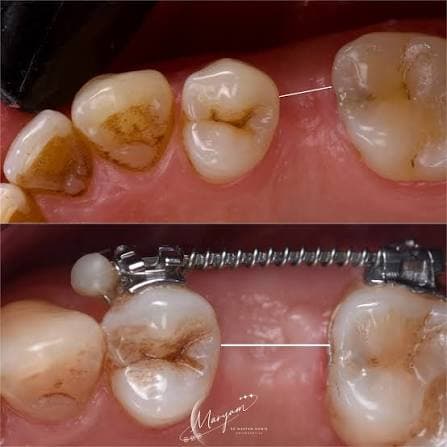
It used to be that opening a space could only be done with bonded/wired ortho.
ORTHO FIRST, RESTO SECOND
"Ortho-resto" simply means using a short course of orthodontics to move the teeth into the best position, then restoring them. It isn't full-blown orthodontic treatment, and the aim isn't a Hollywood smile. It's a targeted few millimetres of movement so that the restoration can be the right size, the right shape and in the right place.
Now with clear aligners, many of these cases need only 3 to 6 months. The patient barely notices them, and the dentist ends up with a far better foundation to work on.
WHERE ALIGNERS EARN THEIR KEEP
Making room for an implant. An implant needs space, not just at the crown but between the roots. As a general guide, you want 1-1.5mm of bone between an implant and the natural root next to it, and around 3mm between two implants. When the neighbouring teeth have tipped into the gap, their roots can block the way even when the crowns look far enough apart. Aligners can upright those teeth and open the space. The surgeon then has room to work, and the gum has room to do its job, which brings us to Tarnow.
THE 5MM RULE: WHY THE GUM CARES ABOUT SPACE TOO
Every dentist knows the dreaded "black triangle", that dark gap between two teeth where the gum/papilla should be. Once it's there, it's very hard to hide, however good the crown is.
In 1992, Dr Dennis Tarnow and his colleagues showed something that every restorative team should keep in mind. If the contact point between two teeth is 5mm or less above the crest of the bone, the papilla fills the space almost every time. Go to 6mm and it fills only about half the time. At 7mm, barely a quarter.
That is the Tarnow principle, and it tells us two things.
First, the contact point has to be in the right place. We can only put it there if the space allows a properly shaped tooth. A natural-looking crown has its contact where nature would put it, close enough to the bone for the papilla to fill in.
Second, squeezing a tooth into a gap that's too small works against you. When the space is too narrow, we're forced to make the crown long and thin, or to taper it in at the neck to fit. That pushes the contact point up, away from the bone, and leaves the papilla with nothing to support it. Squeeze too hard with an implant, and the bone between the implant and its neighbour can be lost altogether. Lose the bone and you lose the papilla, usually for good.
A cramped space doesn't just give you an unnatural-looking tooth. It can cost the patient their gum as well.
Opening the space with aligners first lets us design a tooth with natural proportions, a contact point in the right place and healthy bone either side. The papilla then has everything it needs to fill the gap.
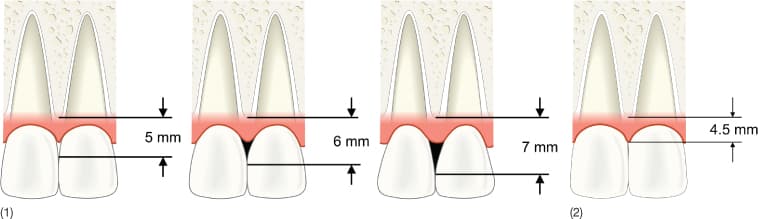
Ideal contact point, the 5mm measurement to the bone crest and the papilla filling the gap (assuming the gingiva 3mm thick av.)
FROM THE BENCH
"Give me the right space and I'll give you the right tooth. Squeeze me into the wrong space and the best I can do is the least-worst tooth."
Every technician knows the feeling of opening a case and realising the space has decided the outcome before we've even started. Proportion, emergence profile, embrasures and gum health all depend on it. A few months of planning at the beginning saves a lifetime of compromise at the end.
PLAN THE FINISH BEFORE YOU START
The real secret of Ortho-Resto is reverse planning. Decide what the final restoration should look like first, then work out where the teeth need to be to make it happen.
That's where we come in. With a digital diagnostic wax-up, we can show you and your patient the finished result before a single tooth moves. We can then plan the aligner movements to create exactly the space that design needs, no more and no less.
Your patient sees where they're heading, you know exactly what you're aiming for, and we know precisely what we'll be making at the end. Everybody is working from the same blueprint.
A FEW PRACTICAL POINTERS
- Keep the gap looking good while it opens. A pontic tooth can be built into the aligner itself, so the patient doesn't walk around with a hole in their smile during treatment.
- Let it settle. Teeth that have just moved will try to go back. Allow a short period of retention before the final impressions or scans, so the space you've worked for is still there when the restoration goes in.
- Retain afterwards. Once the restoration is fitted, a retainer helps protect the result. It's all too easy to skip this step and regret it later.
- Talk to us early. The sooner we see the case, the better we can plan it. A quick scan and a conversation at the start can save a lot of head-scratching at the end.
AC ALIGNERS: ONE TEAM, START TO FINISH
AC Aligners brings the orthodontic and restorative sides of a case together under one roof. Your aligner set-up and your final restoration are planned together from day one, by people who understand both. You don't have to coordinate two different suppliers, and you're not left hoping the space created will suit the tooth that's going into it.
Whether it's a single implant site, a pair of lateral veneers or a full smile makeover, we'd be delighted to help you plan it.
Call the lab on 01765 607347 or send us your scans through your usual scanner portal, and let's talk about your next ortho-resto case.

Ambridge Ceramics Ltd · Ripon, North Yorkshire · MHRA Reg. 5775 · DAMAS Reg. 040111
Talk a Case Through With Us
Have a case where the material choice is in question? Get in touch before work begins , we are always happy to discuss indications, options and anticipated outcomes.
Send a case →Ambridge Ceramics
A multi‑award‑winning UK dental laboratory based in Ripon, North Yorkshire.
Premier House, Kiln Court, College Rd, Ripon HG4 2BP, United Kingdom
- Digital accuracy supported by human expertise.
- Technician‑led decision‑making at every stage.
- Materials chosen for longevity, not convenience.
- Aesthetic outcomes guided by real‑world function.
- The Foundation of Excellence
- Material Intelligence
- Digital Precision
- Hand-Finished Excellence
- Graduated Density
- Shade Matching & Characterisation
- Screw‑mentable Implant Restorations
- The Collective Bench
- Ambridge and the Esthetic Zone
- A Bond That Lasts: The Overlooked Science of Cementation
- The Blueprint Beneath: Why the Preparation Decides the Restoration
- MIND THE GAP (Ortho-Resto) With AC Aligners(we are here)