
Whitening Trays
Expertly designed, vacuum‑formed whitening trays for precise gel placement, superior comfort and predictable results – ideal for in‑practice or supervised at‑home whitening.
Custom whitening trays — hand made in Ripon since the beginning
A whitening gel is only as good as the tray that holds it against the tooth. Every whitening tray that leaves Ambridge is hand-finished in our purpose-built laboratory in Ripon, North Yorkshire, by technicians who have been making them for decades. We were the first laboratory in the UK to offer custom bleaching trays, and we have been making them continuously for more than 30 years including, for all of that time, as the sole tray manufacturer for Optident Ltd’s Labline service.
This page explains how tooth whitening works, why the tray matters as much as the gel, how we make ours, and what the law in the UK says. If you are a dentist, it should answer most of what your patients ask you. If you are a patient, your dentist is the person to talk to but you are welcome to read on.
Guide For
Dentists & Patients
How tooth whitening works
Teeth whiten by oxidation. The active ingredient in every professional whitening gel is hydrogen peroxide either on its own or released from carbamide peroxide, which breaks down in the mouth to give roughly a third of its weight as hydrogen peroxide. A 10% carbamide peroxide gel, the classic at-home strength, releases about 3.6% hydrogen peroxide.
The peroxide passes easily through the enamel and into the dentine beneath, where it reacts with the coloured organic molecules (chromogens) that make teeth look yellow or grey, breaking them into smaller, paler fragments. That is why whitening works from the inside as well as the surface, and why it lightens the tooth itself rather than just cleaning it.
The technique most dentists use today a low-strength gel worn in a custom tray at home, often overnight was described by Haywood and Heymann in 1989 and is still known as nightguard vital bleaching. It was developed after dentists using carbamide peroxide to treat gum conditions noticed the teeth getting lighter as a side effect. Nearly forty years of research since has made it the best-studied whitening method there is.
Scalloped or straight? Reservoirs or not? It depends on the gel
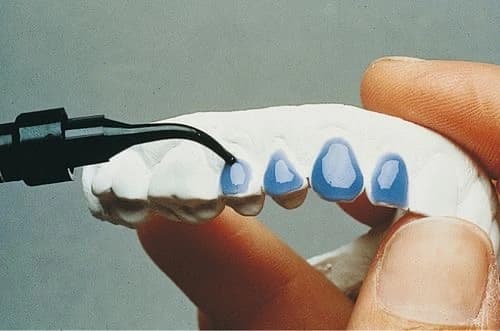
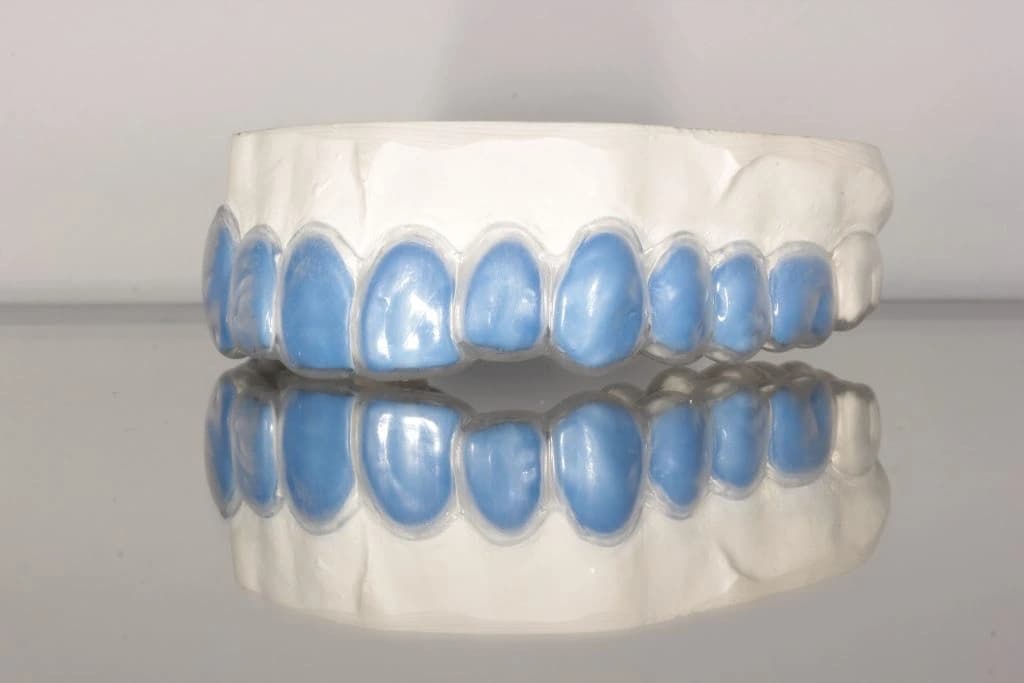
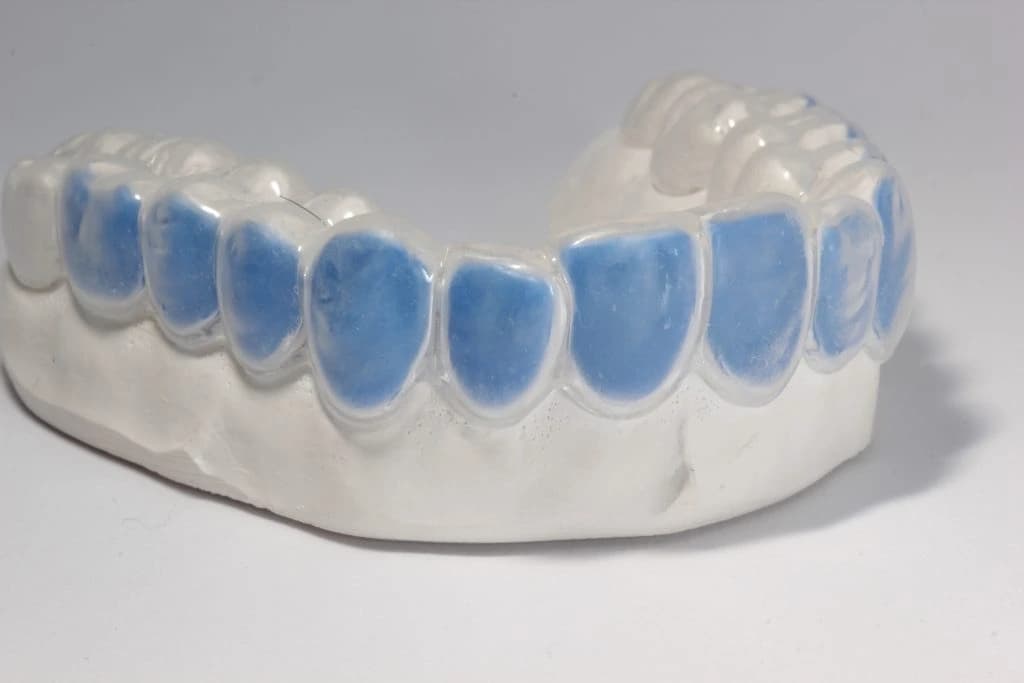
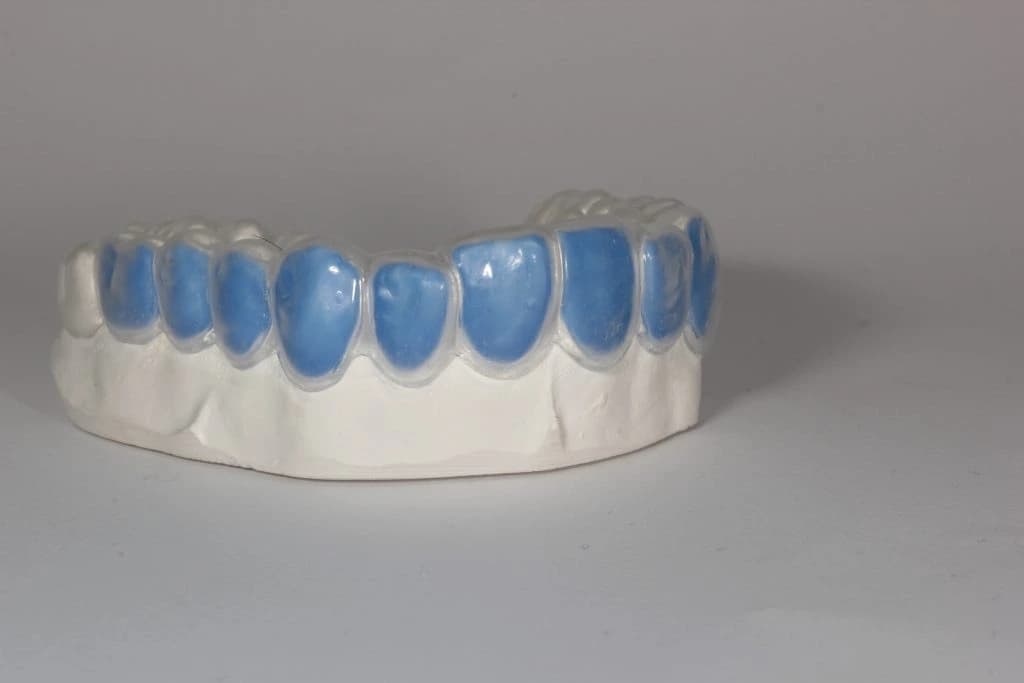
There is no single right tray design it depends on what is going in it. Thicker, more viscous gels stay where they are put, so a tray scalloped neatly around each tooth holds them well and keeps the margin off the gum. Some lower-viscosity gels tend to be runnier, and for those a straight-trimmed edge that extends a millimetre or two onto the soft tissue gives a better seal against leakage. Reservoirs, formed by a spot of block-out resin on the model, do not make the gel work any harder; what they do is give the patient a visible pocket to aim for when syringing, so the right amount ends up on the correct, tooth facing surface every time. Tell us which gel the practice uses and we will make the tray to suit it or specify the design yourself.
Why the tray matters as much as the gel
The gel does the whitening; the tray decides whether it gets the chance. A custom tray is made on an exact model of the patient’s own teeth, so it does four things a shop-bought “boil and bite” tray cannot:
Holds the gel where it is needed.
Every tooth surface gets an even film of gel for the whole wearing time, so the result is even too, no pale patches at the edges, no darker teeth at the back.
Keeps the gel off the gums.
A tray that seals at the margin stops gel leaking onto the soft tissue. Gum irritation is the most common side effect of whitening, and a poor-fitting tray is the usual cause.
Uses less gel.
A tight, thin tray needs only a small bead of gel per tooth; a loose one wastes it and lets it wash out with saliva.
Is comfortable enough to actually wear.
The best whitening protocol in the world fails if the tray sits on the bedside table. Our trays are thin, soft and custom trimmed to the individuals mouth, so patients wear them.
How we make the trays
Every tray starts with an accurate record of the teeth: a conventional impression, or a digital scan from any intraoral scanner. From a scan we print a model; from an impression we pour one. The rest is done by hand.
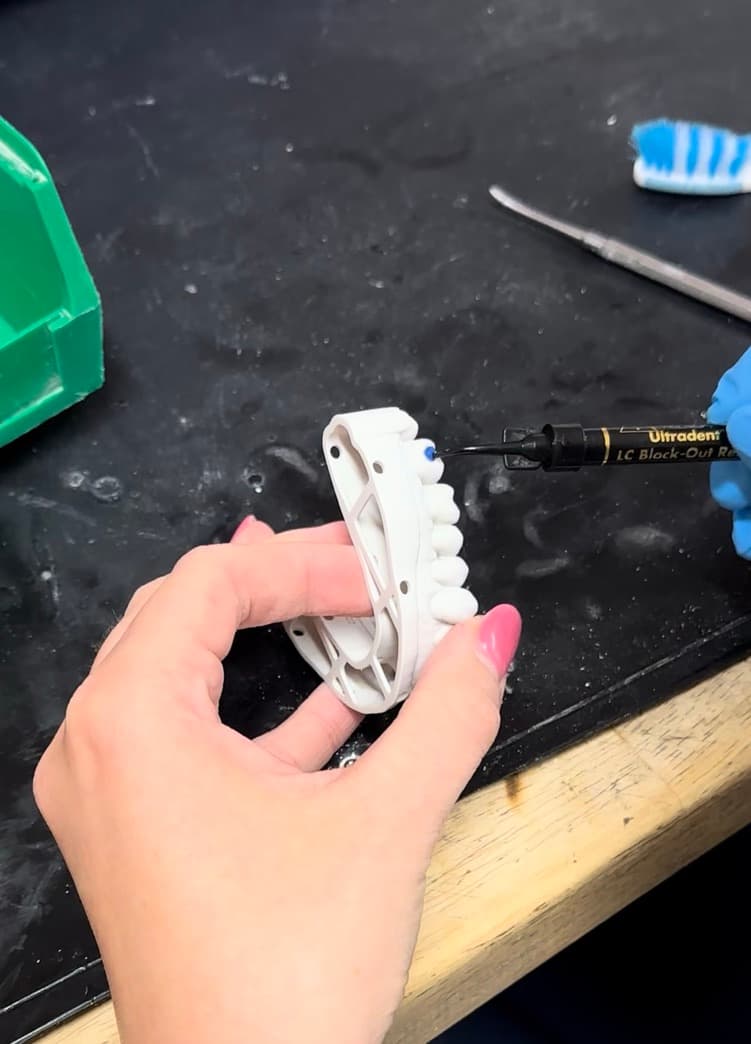
Blocking out
Where the dentist asks for it, light-cured block-out resin is placed on the labial surfaces of the model to create a small reservoir in the finished tray.
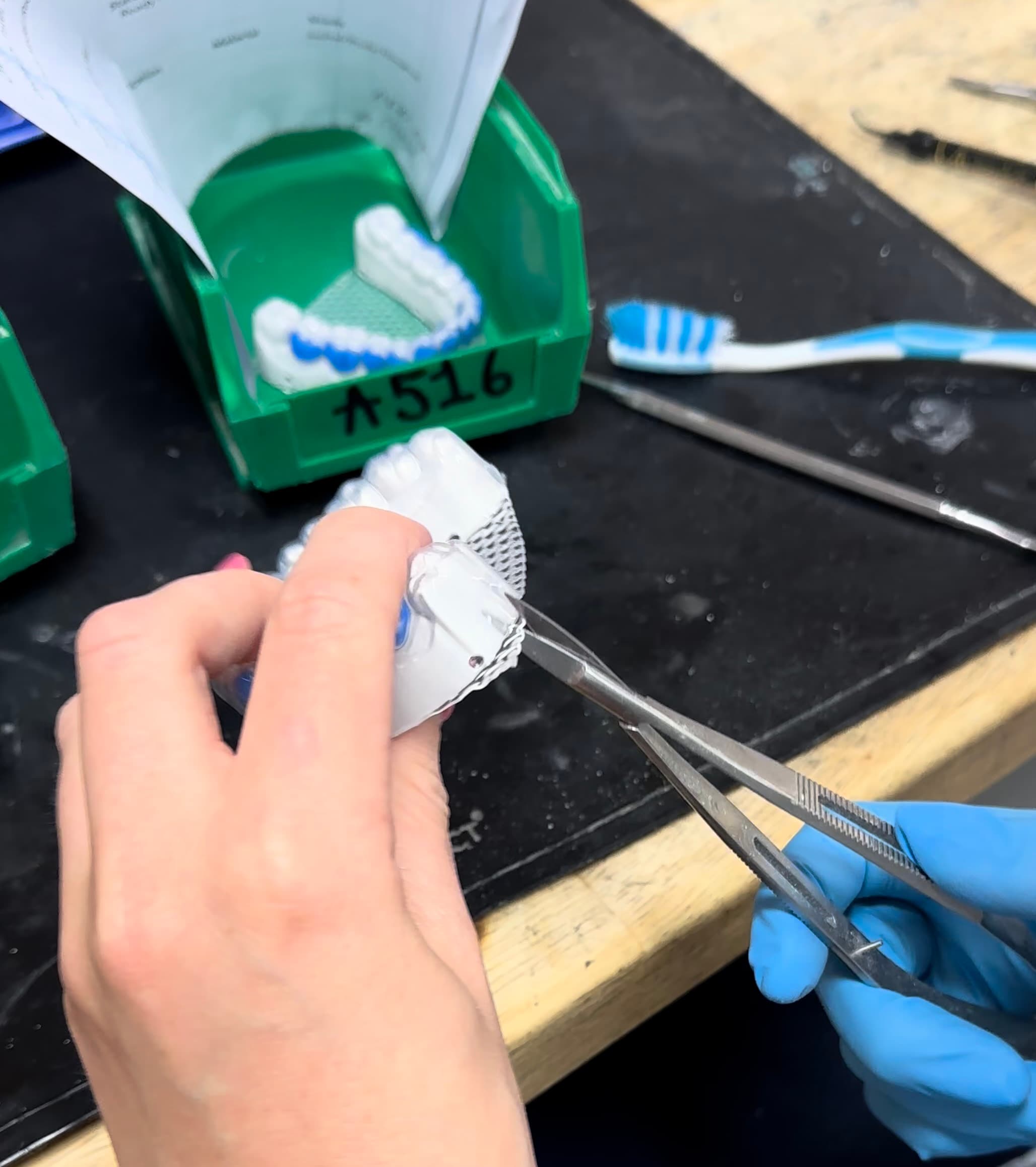
Forming
A sheet of soft ethylene-vinyl acetate (EVA), typically 1.5 mm, is heated and vacuum-formed over the model so it takes up every contour and is subsequently thinned down to 0.9-1.0mm.
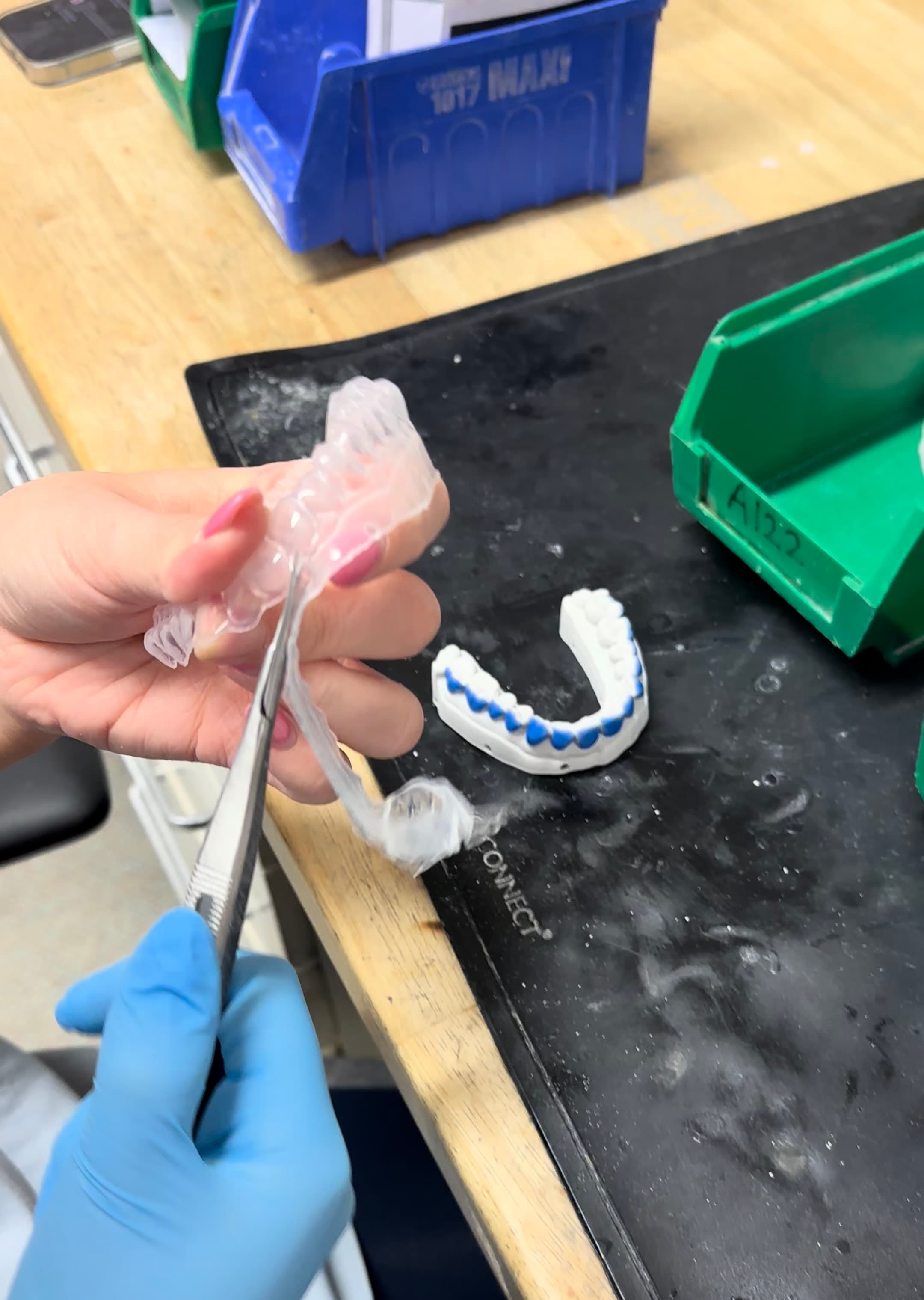
Trimming and finishing
The tray is cut back to the margin the dentist has prescribed scalloped around each tooth or straight-cut just beyond the gum line then smoothed and polished by hand so there are no rough edges to catch the lip or tongue.
Checking and packing
Each tray is checked on its model, then returned in a storage case together with the blocked-out models, so a lost or damaged tray can be remade without a new impression.
Turnaround is reliable and fast; (maximum 2 days in the lab) however, ask us for current timings. Digital cases are formed and finished to exactly the same standard as conventional ones.
What the dentist needs to send
An impression (upper, lower or both) or a digital scan from any scanner, 3Shape, iTero, Medit, Primescan and any or all others are fine.
Instructions which arches, and whether you want reservoirs and a scalloped or straight margin. If you don’t say, we will make what we have made for you before.
Anything unusual Teeth to amend their shapes or leave out of the tray, windows for a tooth to be treated on its own, or a patient with recession or sensitivity who needs a particular design.
What patients can expect
Most people use a low-strength gel in the tray for a couple of hours a day, or overnight, for two to four weeks. Deep, grey or brown discolouration or tetracycline staining for instance responds more slowly and can need several months of nightly wear.
Some sensitivity is common in the first few days and usually settles quickly; dentists often recommend a fluoride or potassium nitrate toothpaste, shorter wearing times, or a break of a night or two. Existing crowns, veneers and fillings do not change colour, so your dentist will talk to you about those before you start.
Results last well. Long-term studies of home whitening with custom trays report a good proportion of patients still satisfied with their shade years after a single course, and a short top-up with the same trays brings the shade back when it does drift one more reason to keep the trays and the models safe.
IMPORTANT: Tooth whitening and the law in the UK
Tooth whitening is the practice of dentistry. The High Court confirmed in GDC v Jamous (2013) that tooth whitening can only legally be carried out by a dentist, by a dental hygienist or therapist working to a dentist’s prescription. Anyone else offering it, a beauty salon, a kiosk, a home visit, is committing a criminal offence under the Dentists Act 1984, whatever the strength of the product, even if the product is 0% CP/HP.
The strength itself is limited by the Cosmetic Products Enforcement Regulations 2013: whitening products may contain or release up to 6% hydrogen peroxide (roughly 16% carbamide peroxide), the first application in each course must be by, or under the direct supervision of, a dentist, and products in this range may not be used on anyone under 18. Products sold directly to the public are limited to 0.1% hydrogen peroxide, which is considered too weak to effectively whiten teeth.
A custom tray made by an MHRA registered dental laboratory to a dentist’s prescription is a custom-made medical device. Ours are made in the UK, in our own laboratory, and each one is supplied with the patient statement of manufacture the regulations require.
MHRA Registered Lab
Custom-made medical devices with full statement of manufacture.
30 years of whitening trays
Ambridge Ceramics was the first laboratory in Britain to offer custom bleaching trays, not long after the technique was published, and has made them ever since. For more than 30 years we have also been the sole manufacturer of bleaching trays for Optident Ltd’s Labline service, supplying practices across the UK through Optident and Henry Schein. Whichever route a practice orders through, the tray is made here, by hand, by the same team and the same team is on the end of the phone for any issues, fit queries and remaking.
Frequently asked questions
Facts and where they come from
| Claim in the copy | Source |
|---|---|
Whitening works by oxidation; peroxide diffuses through enamel to dentine and breaks down chromogens | American Dental Association, Oral Health Topics: Whitening |
Carbamide peroxide releases about one-third of its weight as hydrogen peroxide; 10% CP ≈ 3.6% HP | ADA (above); Dental Protection, “Whitening within the law” |
Nightguard vital bleaching described by Haywood & Heymann, 1989, after lightening noticed as a side effect of gum treatment | Haywood VB, Heymann HO, Quintessence Int 1989; Pocket Dentistry, “Nightguard Vital Bleaching” |
Dentist-dispensed tray gels 10–38% CP, worn 2–10 hours a day for 6–28 days | American Dental Association (ADA) |
Sensitivity in up to two-thirds of users early on; mild and transient; usually settles within days | ADA (above); Cochrane review CD006202 (2018) |
Tetracycline staining may need 3–4 months of nightly wear | ADA (above) |
Existing restorations do not change colour | Pocket Dentistry (above) |
Long-term satisfaction: 74% at 1.5 yrs, 62% at 3 yrs, 43% at ~10 yrs, 35% at up to 17 yrs, without re-treatment | Leonard/Haywood et al., 9–12 yr and 10–17 yr follow-ups (J Esthet Restor Dent), summarised at Pocket Dentistry |
Home whitening works vs placebo, but evidence is low to very-low certainty; no method or concentration shown superior | Cochrane review CD006202 (2018) |
Tray material: 1–1.5 mm soft EVA is standard; foam-lined alternatives no better | Dentistry.co.uk, “A literature review of bleaching tray design and efficacy” (2018) |
Tooth whitening is the practice of dentistry — GDC v Jamous [2013]; unregistered whitening is a criminal offence under the Dentists Act 1984; unlimited fines | General Dental Council, “What the law says” |
Max 6% HP for dentists; first use by or under direct supervision of a dentist; not for under-18s; 0.1% limit for products sold to the public | Dental Protection (above); GDC (above); Cosmetic Products Enforcement Regulations 2013 |
REFERENCES
- General Dental Council — Tooth whitening and illegal practice: what the law says. gdc-uk.org
- Dental Protection — Whitening within the law. dentalprotection.org
- American Dental Association — Oral Health Topics: Whitening. ada.org
- Cochrane — Home-based chemically-induced whitening (bleaching) of teeth in adults, CD006202 (Eachempati et al., 2018). cochrane.org
- Dentistry.co.uk — A literature review of bleaching tray design and efficacy (2018).
- Haywood VB, Heymann HO. Nightguard vital bleaching. Quintessence International 1989; and Haywood VB, Current status of nightguard vital bleaching.
- Pocket Dentistry — Nightguard vital bleaching; and Post-treatment effects, longevity and long-term results (summarising Leonard, Haywood et al. 9–12 year and 10–17 year follow-ups).
- Cosmetic Products Enforcement Regulations 2013 (implementing EU Regulation 1223/2009 as amended by Directive 2011/84/EU).